Friday, February 5
As per request of Jesse, a post on liberation theology.
It was a short flight from Guatemala, Guatemala to Managua, Nicaragua, but that didn't mean that Friday wasn't a long day or that we weren't exhausted. We stayed at Palm Point, a fancy little hostel used by missionary groups, where we napped in hammocks and had class. Probably the worst thing you can do planning wise is schedule a 6am flight and a concert on the same day. What were the profs thinking? When evening rolled around and I was in the middle of a blissful nap, we were roused to go see the man himself, Carlos Mejía Godoy.
In our our prep class last semester, Latin American Culture and Civilization, our prof introduced the topic of liberation theology to us with a song, Vos sos el Dios de los pobres, by Carlos Mejía Godoy. How does popular folk music fit into theology? Let's back up to the Second Vatican Council held from 1962-1965.
The world was changing and it was about time the Catholic Church did some major housecleaning. The result of Vatican II was a church more accessible to the laity. Mass was now to be held in the vernacular of the people, not Latin, and more emphasis was placed on the Bible. (Previous Church decrees discouraged or even forbid lay people to read the Bible in their mother-tongue, for fear of bad translations or misinterpretations.) Now, the amount of scripture to be read in mass was greatly expanded, and lay people were encouraged to study the Bible for themselves in their own language. Additionally, Protestants and Eastern Orthodox Christians were declared "separated brethren" rather than outright heathen.
How did the "spirit of Vatican II" affect the Church in Latin America? In 1968 in Medellín, Colombia, all the Latin American bishops got together. Where before priests had gone alongside conquistadors, and later with oppressive governments, the conference recognized that the Church should stand with the poor. This "preferential option for the poor" meant that God loved the poor and oppressed in a special way, and that he didn't want for their suffering to continue.
Another development were base communities. Latin America, then and today, had a scarcity of priests. No priest, no mass, right? Not anymore. In base communities, Catholics met to study the Bible and also to take positive action in their towns and neighborhoods. They became active in politics and in finding practical ways to improve their standard of living. When a priest visited, they did all the sacraments, but base communities were so much more than liturgy. Some were even ecumenical, bridging the rift between Protestants and Catholics.
The thought behind all this became known as liberation theology: the teaching that the suffering of the poor is preventable, it's systematic, and by golly let's do something to change that.
Henri, an ex-priest turned Protestant and a teacher at Casa Xelaju, explained liberation theology like this: there are some travesuras that come from God, and some travesuras that come from people. Some of the bad stuff in the world, some suffering, some mischief, is indeed from God. But far too often people say, "this travesura is from God, it's my lot in life, I can't do anything about it," when really it's the fault of people. And understanding that much of the travesuras in life are from people, and are changeable, that's liberation theology.
It's important to understand that liberation theology wasn't actually a
new thing. Caring for the poor has always been commanded of believers. It wasn't "Christianized Marxism." It was the message of the
gospels interpreted and claimed by people who knew the depths of poverty
and systematic oppression. It was the enthusiasm of the masses given
access to the Word of God.
Of course, this was going on in the 60s and 70s, at the same time that popular revolutions were happening and regimes were being toppled all over Latin America. Some took the idea of liberation theology, of changing their lot in life, and ran with it to support violent uprisings. Most believed in peaceful measures. Dictators saw any peasant organization, education, or sympathetic clergy as a threat. Conveniently label such activities as communist, and the United States Government during the Cold War pours out money and military aid to bad dictators.
So where does Carlos Mejía Godoy come in? In the 60s and 70s Nicaragua was going through a revolution to get rid of the Somoza family dictatorship. Mejía Godoy, talented musician and witty song writer, avidly supported the revolution and the FSLN (Frente Sandinista de Liberación Nacional) and composed songs to stir up feelings of patriotism and activism. (He's not a big fan of the FSLN or Daniel Ortega now.)
One of his albums, La Misa Campesina Nicaragüense, is an entire liturgy for mass that uses common instruments like the marimba and guitar, and depicts
God as close, personal, as one of the people.
Vos sos el Dios de los pobres (You are the God of the poor), is different first of all because it uses vos. Traditionally you talk to God in usted -- the formal, respectful way to say "you." Then there's tú, the informal way we were taught in Spanish class. But Nicaragua has a third way to say "you," a colloquial form that wouldn't be found in academic writing. That's vos. The way you address God, as a distant Lord in all his glory or as a close, intimate friend, is huge.
The song goes on to describe God. He's the God who sweats in the streets, the God with the tanned face, the God who eats in the park with Pancho and Juan José. God stands in line to get payed at the end of the day. And when the snow-cone guy doesn't put enough syrup on, God protests to get his money worth. He wears overalls and pumps gasoline, he sells lottery tickets -- the job reserved for blind people, he is el Cristo trabajador.
At the restaurant where the old man Carlos Mejía Godoy and his band performs every Friday night, we struggled to keep from nodding off while folk music was played loudly and enthusiastically, and Mejía Godoy cracked jokes none of us understood. He sang a different song from his misa campesina, El Cristo de Palacaguina. It tells the tale of how baby Jesus was born in Nicaragua, in the little pueblo of Palacaguina. Everyone in the crowded, tobacco filled room sang along.
Thursday, April 7, 2016
Tuesday, March 29, 2016
Day 32: Convento de las Capuchinas
February 3.
Consecrated in 1736, el Convento de las Capuchinas was the first in Guatemala that didn't require money from its nuns. All the other convents required dotes, literally "dowry." This meant that only women from rich families could become nuns, and effectively made de las Capuchinas the first to accept indigenous women.
There was room for 25 nuns, who led a contemplative and cloistered life. After joining the order, a nun would never see her family or the outside world again. Even after death, her family wasn't permitted to see the body. A "graduated" nun was buried under the chapel with a crown of white roses and a ring that symbolized her marriage to God (while alive, she was engaged). Their tiny cells had the barest of furniture, they spent days at a time praying (I know, "pray without ceasing," but days), and were guarded closely by the mother superior. So why become a nun? Our friendly tour guide, who was a real nerd about architecture, gave us two reasons. If you were rich and embarrassed your family, sending you to a nunnery to keep you out of the public eye was a viable option. If you were poor and systematically oppressed, this was an opportunity for education, (relative) comfort, and to always know where your next meal would come from.
Our guide told us that the construction of the convent and chapel of Capuchinas was designed with a mix of Maya and European influences. I'm not sure whether the inclusion of Maya themes was deliberate or just came about because of the surrounding culture.
All of the other colonial chapels in Antigua are orientated north-south, las Capuchinas is east-west. The little window in the back illuminated the alter with the rising sun. The sun is a Big Deal in Maya cultures.
The design implemented a lot of circles and arcs, as you can see in chapel. Circles represent perfection and infinity. In the Maya fire ceremony a circle is drawn to ask permission (of the earth or of the gods, I'm not sure) to perform the ritual. In Spanish architecture, the square was the favorite shape. Arabic influence on Spain brought the octagon, another shape of perfection.
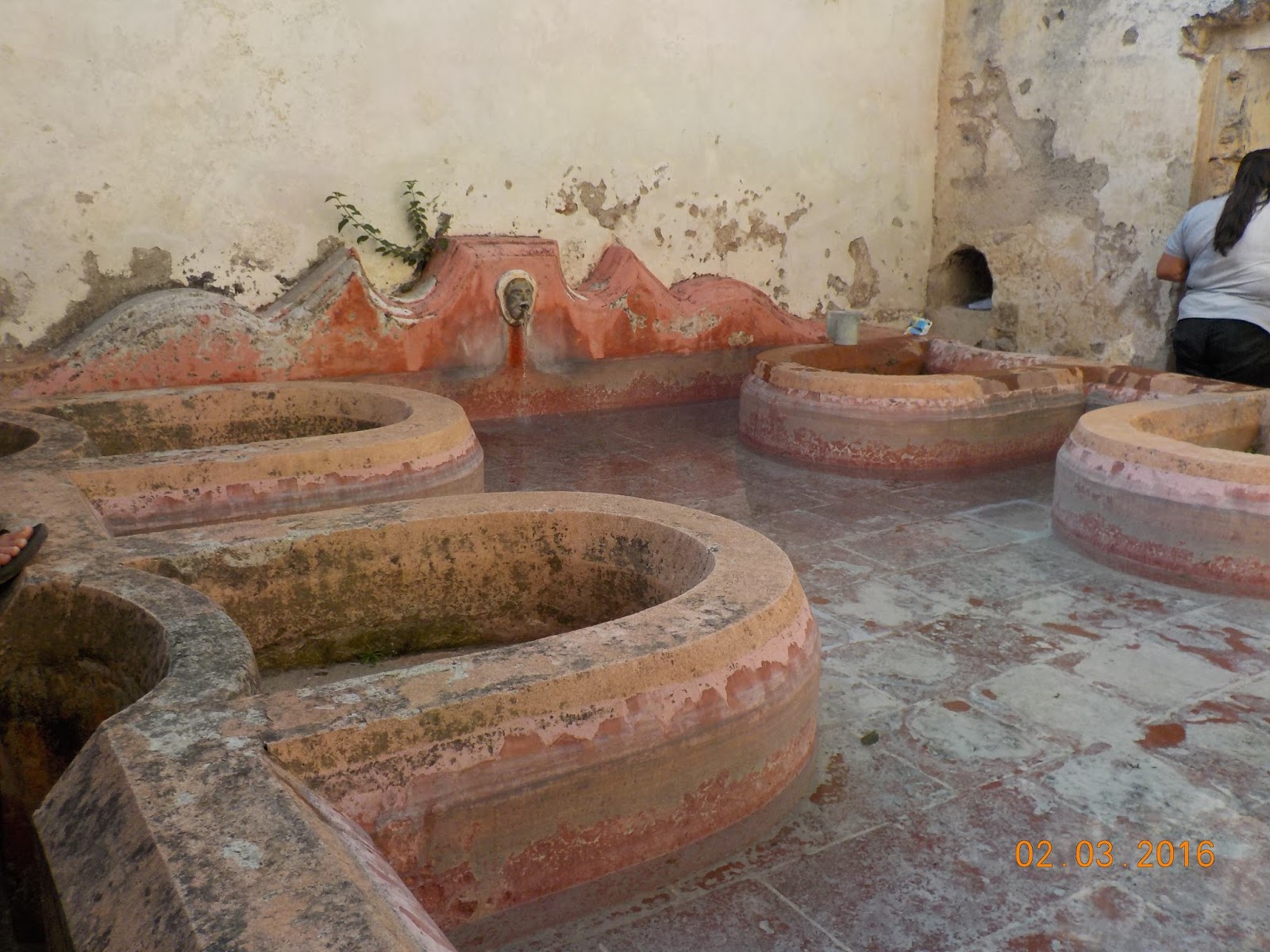
This fountain, as well as the one in the central park of Antigua, makes use of all three perfect shapes. The Arabic octagon, the European square, and the Maya circle.
The cross also has a Maya significance. The symbol existed in Central America before the conquista. The four points correspond with the four cardinal directions, the four colors of corn, and a person's four grandparents.
This is what facebook looked like, back in the day.
The kitchen. The stove is called a poyo because the servants would lean on the wide edge, from the verb apoyar, "to support." It has nothing to do with chicken.
"Don't sit on the archaeological pieces!"
The nuns' only communication with the outside world came by way of a Lazy Susan in the wall to receive letters, gifts, and meals. This one connected the kitchen to the convent, the nuns never even saw their servants. In the chapel wall next to the alter is a little grated window for them to receive the Eucharist. There is also a special corridor where a nun could visit her family on the other side of a door. The corridor was curved in an L shape so the mother superior could secretly stand behind the nun and hear everything.
That's a door, a door post, and a hinge made out of a chain.
Our guide stressed that these ladies lived in comfort. They had hot water, bathtubs, and a sauna equipped with an arm rest to help with meditation.
On the left is a toilet.
The main feature of the convent is the round tower. If you stand on the tile in the exact center your voice echoes back at you, which is pretty cool. Around the circumference are little cells where the nuns might spend days at a time praying.
On the outside of the tower you can see holes that were chimneys for the candles in the little cells. Our guide was very excited about the triangle that sticks out above the chimney hole, to keep rain water from falling inside.
Underneath the tower is a round basement with incredible acoustics for singing. Our group is blessed with a singing professor and two choir members, and you can bet we took advantage of that.
This concludes the long overdue Antigua series. Maybe soon you'll see pictures of Nicaragua.
Monday, March 28, 2016
March: Papusas
Day
one of
living with my Nicaraguan host-family we spent the evening, as we
would spend many evenings, at the papusa house. My host-mom Elizabeth
and her sister Rocío
run
a pulperia (a
mom and pop store) and sell papusas out of Rocío's
house. It turns out my family isn't Nicaraguan, but Salvadoran.
Papusas are a typical Salvadoran food, they're basically thick
tortillas stuffed with sausage, cheese, and/or beans, and are
delicious. (They're also typical of Nicaragua, but I am assured that
Salvadoran papusas are better. I have yet to discover the
difference.)
The
outside of
the papusa house has
plastic tables and chairs set up and a half-finished painting of two
women and a grill full of Papusas
Cuscatlecas
on the green wall. The inside is mostly
bare
except for the partition
of wooden
shelves that make up
the store and the corner where papusas are hurriedly prepared. My
host-family
has
lived in Nicaragua almost five years, Rocío moved her family here
barely three months ago.
Upon
arrival that
first day my
two little brothers,
Samuel and Andrés,
ran
off screeching to play with their cousin, Daniel. Elizabeth jumped
into papusa mode with a
woman who's name began with “R.” I
was
left
alone
in the living room with
the mostly deaf, one-legged grandma rocking sedately in a wicker
chair with a broken seat. We attempted
polite conversation but
ended up just smiling and nodding at each other.
Unsure
of
my place in the universe at this point, I hovered
near the table with the papusa ingredients and asked
to help. My
papusas were too small and not exactly round.
A
few times a week we spend the evening at the papusa house. My cousin
Gabi
has latched onto me. She's
ten years old, too old to run crazy with the three little boys, but
cooped up in the house with papusas and one TV channel. She likes to
steal my phone, grab my arm to drag me around, and find other ways to
be a nuisance. Entertainment improved drastically after I bought a
deck of cards.
For dinner I am offered a choice of papusas or something else. I
usually go with three or four papusas. Elizabeth and Rocío always
ask if I'm bored of eating them yet – nope! They smile and say that
after eating papusas their whole lives they're not tired of them
either. Rocío always eats with her hands but Elizabeth prefers a
fork. Rocío argues it's the traditional Salvadoran way to forgo
utensils but my host-mom has the health department on her side: it's
okay to use your bare hands in preparing papusas because they're
cooked, the health concern is that the consumer doesn't wash their
hands before eating.
As
a routine developed over time I found I couldn't break the ice with
Elizabeth. It seems that
neither of us are blessed with the gift of small talk. She's also
busy most of the time, which doesn't lend itself to cozy chats. As
she makes my breakfast in the morning she runs between the stove and
the bedroom to get her sons ready for school, and
in the evenings she's busy with papusas.
We do share an affinity
for pretty clouds. When
she's driving she'll point out interesting sky activity but otherwise
conversation doesn't flow
between us.
I
like to stand with
Elizabeth or Rocío and pat masa
in my palms. It
gives me something to do besides endless rounds of kings in the
corner with Gabi, and when hands are busy it frees up the mouth.
Last week Elizabeth begged me to help her sell papusas on the street.
Rocío's house in a quiet neighborhood isn't the best location to
attract customers' attention. Recently Elizabeth found a spot next to
a busy bus stop where she's swamped with hungry commuters. I've only
helped her once, but I can't imagine how she does it on her own.
After we set up the grill and a plastic table full of all the
supplies, I asked Elizabeth if I should holler at passersby to buy
papusas like most street vendors do. She looked appalled. “If you
want to” she answered. She made just short of a million
papusas, and as fast as she could make them I was bagging them,
handing them off to customers, and counting cordobas.
Conversation had always been stilted before this, but when it was
just the two of us and papusas sizzling for hours, it became easier.
She encouraged me to interview customers for my theology paper, since
“Nicaraguans love talking about religion.” When I was reluctant
she did it for me, immediately asking a woman at random about her
church.
After that evening I think we began to stop tip-toeing around each
other. It can be hard to ask questions to get to know a person. You
think about everything that could go wrong – you'll pronounce a
word wrong, she won't want to talk, the question is too personal...
but usually no harm is done. Conversation comes easier over papusas.
Wednesday, March 16, 2016
Day 74: Spanish tidbits
March 16.
Because I haven't completely forgotten about blogging, and I don't feel like writing anything long.
- I like that in Spanish "I'm sleepy" is tengo sueño = "I have dream."
- And that you don't blow your nose, you sonar = sound it.
- In Nicaragua, the answer to ¿Cómo estás? if positive, is often accompanied by gracias a Dios in a quick, casual way. "Bien, gracias a Dios, ¿y usted?"
- For a fun time, ask a Spanish-speaker to say "puppy," "poppy," and "poopy."
- And then get made fun of when you can't roll your R's.
- "To lend" and "to borrow" are the same, prestarse. This seems ridiculous to me, but I've been told that for Spanish-speakers learning English it's confusing that they're two separate notions.
- Adding --ito to the end of everything is fun.
- "Platypus" is ornitorrinco.
Wednesday, March 9, 2016
Day 30-33: pretty building
February 1-4.
While in Antigua we had group meetings every day to debrief and listen to Lindy spout theology. We even had two guest speakers, both missionaries. Our favorite place to meet was an old colonial building that is beautifully restored. It's actually owned and maintained by Spain. It has a cafe, an art exhibit, a library, and it's free of charge. We drank a lot of fancy coffee there.
Some of the art included these big sculptures of beans. They were labeled "NOT FOR SITTING."
The building had 4 or 5 courtyards, which were all lovely like this one.
Some of the rooms were left in a state closer to the original.
Monday, March 7, 2016
Day 65: a good day
Today.
More details and an update on the internship.
On Thursday the whole administration went to a meeting outside the school. Mitch had repeatedly tried to talk to some of the sub-directors about finding more work for me. They would say, "yes of course we have plenty of work for Hannah!" but then they would never follow up and give me work. On top of that, when one of the English teachers was sick, the director asked if I could teach her classes. He still thought I was a student-teacher!
Fed up, we decided to skip the talking and we marched over to the main office, where profe Kenya was trying to keep the school afloat by herself. She's the one who everybody goes to when they need something: parents, students, staff, everyone. And she had plenty of work for me.
The office will be my new place. Mitch and I realized that the best way for me to practice Spanish and be useful to NCA is to get out of the English teachers' lounge. I still help with the kindergarten English classes, and coming up next week the secondary students have an English writing workshop that I'm excited for. Mitch wants me to help mark the papers for grammar and organization, which is right up my alley.
Today I wasn't bored for one minute. I finished checking the new student ID cards off the list, cut out letters for signs, played hoky-poky with kindergarteners, kept Dulce (who has Down syndrome) entertained so the teacher could teach, and then went through a sea of manila folders with the nurse.
I feel like I was just making friends with the English professors, and now I have to figure out how to understand the people in the office. With new people, my Spanish acts like an animal that's about to be roadkill. Give it a few days and I get used to their voice and can understand them. That means that during first impressions I come off like an idiot who doesn't know anything, and have to spend the next month convincing them that yes, I do understand Spanish, just not at 6 in the morning or if you're mumbling. I can't understand 70% of what the director says -- that man has the Yorkshire accent of Spanish.
I also had a really good weekend. Friday I saw Deadpool with two ISEP students and learned how to swear in Spanish. Rude language is more fun in English, in my opinion, because the F-word is so versatile. You can stick it anywhere in a sentence, even in the middle of a word. That doesn't work in Spanish. Saturday and Sunday I hung out with Camina and her host-parents... who are more like big siblings. Top that all off with history's first good Monday, and you have a happy Hannah.
More to come soon, I promise! Oh wait, is that the sound of a 10 page paper needing to be written? Noooooooooooooo (at least it's in English).
More details and an update on the internship.
On Thursday the whole administration went to a meeting outside the school. Mitch had repeatedly tried to talk to some of the sub-directors about finding more work for me. They would say, "yes of course we have plenty of work for Hannah!" but then they would never follow up and give me work. On top of that, when one of the English teachers was sick, the director asked if I could teach her classes. He still thought I was a student-teacher!
Fed up, we decided to skip the talking and we marched over to the main office, where profe Kenya was trying to keep the school afloat by herself. She's the one who everybody goes to when they need something: parents, students, staff, everyone. And she had plenty of work for me.
The office will be my new place. Mitch and I realized that the best way for me to practice Spanish and be useful to NCA is to get out of the English teachers' lounge. I still help with the kindergarten English classes, and coming up next week the secondary students have an English writing workshop that I'm excited for. Mitch wants me to help mark the papers for grammar and organization, which is right up my alley.
Today I wasn't bored for one minute. I finished checking the new student ID cards off the list, cut out letters for signs, played hoky-poky with kindergarteners, kept Dulce (who has Down syndrome) entertained so the teacher could teach, and then went through a sea of manila folders with the nurse.
I feel like I was just making friends with the English professors, and now I have to figure out how to understand the people in the office. With new people, my Spanish acts like an animal that's about to be roadkill. Give it a few days and I get used to their voice and can understand them. That means that during first impressions I come off like an idiot who doesn't know anything, and have to spend the next month convincing them that yes, I do understand Spanish, just not at 6 in the morning or if you're mumbling. I can't understand 70% of what the director says -- that man has the Yorkshire accent of Spanish.
Kinder 2, 4-5 year olds. There are three kindergarten classes, the first only has seven students and is more like preschool, and the third is a full class preparing for primary school. They're not wearing uniforms because we have casual Friday, or día de colores. As you can see, coloring is no simple task.
More to come soon, I promise! Oh wait, is that the sound of a 10 page paper needing to be written? Noooooooooooooo (at least it's in English).
Thursday, March 3, 2016
February: a summary
This isn't nearly all that I want to say, but it's been a month and I haven't written anything about Nicaragua. So here's a little about what I've been doing. I'll catch up with Antigua and write about Nicaragua in more detail eventually.
Expectations can be
misleading. Our professor told us to pack four months worth of
feminine hygiene products, a drug store, a small fortune in spending
money, and to kiss wifi goodbye. It turns out she's the over-prepared
type. I live in the capital city and as such my home in equipped with
cable, wifi, and safe drinking water. Oddly enough, living 4,200
miles away from home is perfectly comfortable (minus the 90 degree
weather and the mosquito bites).
A brief summary of
the program: I'm here through the Central America Service Program
(CASP), and “here” is Nicaragua, which is not a country in Africa
(that's Nigeria), is not the same as Mexico, and does not spell
certain mugging and malaria for tourists. I have a host family, an
internship five days a week, and homework which my professors at
Whitworth are eager to assign. The goals are to be immersed in
Spanish and the Nicaraguan culture, and to gain work experience
pertinent to my future career. That's my life for February, March,
and April.
As for the two CASP
goals: my host family is from El Salvador, and I'm an intern in the
English department of a private school. Immersion? Salvadorans
complaining about Nicaraguan food and weather, co-workers who teach
and communicate largely in English. Relevant work experience? How fun
it is to be an English major when the whole world assumes that means
“teaching.” Expectation of a perfect semester abroad?
Unrealistic.
First the bad: the
day I went to meet my boss, the principal of Nicaragua Christian
Academy (NCA), he didn't have time to do more than shake my hand. I
was sent off to find my supervisor, Mitch, who busy principal had
neglected to tell was getting an intern. An intern who lacks any
ability or interest in teaching, no less. As the days passed, Mitch
and I talked about all of the possible projects I could be a part of.
Some of these sound really cool – I am especially looking forward
to when the secondary students have their English writing workshop –
but so far most of these ideas haven't manifested themselves as
physical work. The problem
isn't a lack of work to be done, but a lack of people who can tell me
what to do. NCA
suffers from a severe case of faculty
disorganization.
The
biggest challenge, well really it's a disappointing lack of a
challenge, is that the English team all speak English. They're the
people I have the most contact with. Today, for example, I had a
conversation with one teacher about books. I started out asking her
questions in Spanish but she kept responding in English, after the
third try I gave up.
Each
day is getting better. I just have to get over my pessimistic ways
and see it. The folk at NCA are open and friendly; surely I can
compensate for the time spent speaking English by seeking out
conversations with people outside the department. I enjoy grading
homework, something the teachers loathe to do. As long as they keep
assigning homework I won't be completely devoid of tasks to do. The
writing workshop is happening soon, and a certain elusive professor
with tasks for me can't hide forever.
Now the good: my
host-mom and aunt sell Salvadoran papusas! Papusas
are thick corn tortillas with cheese, meat, and beans inside them.
They're fun to make and even more fun to eat. Typical Nicaraguan food
is bland and loaded with queso seco, a
boring cheese. The perks of having a Salvadoran family is that their
food is better and their accent is clearer. Nicaraguans have a habit
of dropping the S's from the ends of words – dos
becomes “doh” and so on – which can be a real pain for someone
who's learning the language.
My
two little host-brothers are five and seven years old,
they love dinosaurs and Plants vs. Zombies.
The older one likes goats but the younger one is scared of them. I am
continually in awe of their parents' endless patience. They're not
particularly difficult kids, but I would have strangled them by now.
I see my host-cousins almost every day. Entertainment improved
drastically after I bought a deck of cards, but now I need to think
of more games to teach them.
If
there's anything I've learned from my family and my internship, it's
that all kids are crazy. So go, thank your parents for not killing
you, and give teachers a higher salary.
Subscribe to:
Posts (Atom)